Waitrose
Creative Director: Andy Lewis
Data Analyst: Ethan Richards-Cole
Service Designer: Dan Ramos
Designer: Jacob Everett
Junior Consultant: Natasja Derry
#EXPERIMENTATION #MARKETING
From lean agile experimentation - to recovering £6m in lapsed retail value
The Challenge: After a massive "Regen" store rollout (focused on logistics and hardware), Waitrose saw a significant downturn in customer retention. I led a five-person lean task force to experiment on the two worst-performing stores in the UK, operating with a seven-week deadline and a "too little, too late" brief.
The Strategy: By using a combination of customer-led (‘Have your say’ surveys) and data-led (Pathz loyalty data) we bypassed corporate bottlenecks to unlock potential solutions, and identify the exact neighbourhoods of "Absolute Lapsed" and "Decliner" shoppers.
-
Guerrilla intervention: By operating in lean-agile sprints, we executed boots-on-the-ground experiments—from "Bag Swaps" outside rival stores to "£40 Shop" value-perception displays.
-
The mischief factor: We secured trust with the internal design team to use unreleased new Waitrose branding for lo-fi interventions, helping to signal a "Fresh Start" to cynical customers.
The Impact: Delivered a 21% uplift in sales among decliners and a 28% increase in basket size at the Parkstone store.
-
The scalable win: We identified a £3m–£6m national opportunity and codified our methods into a "Post-Regen Activation Playbook" now used by the Waitrose Local Marketing team.
-
Cultural shift: We upskilled internal stakeholders in agile ideation and "Build-it, Break-it, Fix-it" methodologies.
The "too little, too late" brief
We were handed the keys to a sinking ship. Waitrose had invested millions in a national "Regen" store rollout, but the data was showing an alarming downtick in customer behaviour. I was assigned the two worst-performing stores in the UK—locations that had been haemorrhaging value for over six months.
In the world of high-end retail, this was a "set up to fail" scenario. My role was to shift the team from a mindset of damage control to strategic optimism. We weren't there to just fix signs; we were there to prove that a lean, agile approach could stabilise a business crisis in seven weeks—a timeline that traditional corporate structures usually spend just ‘aligning on’.

Going after the right problem
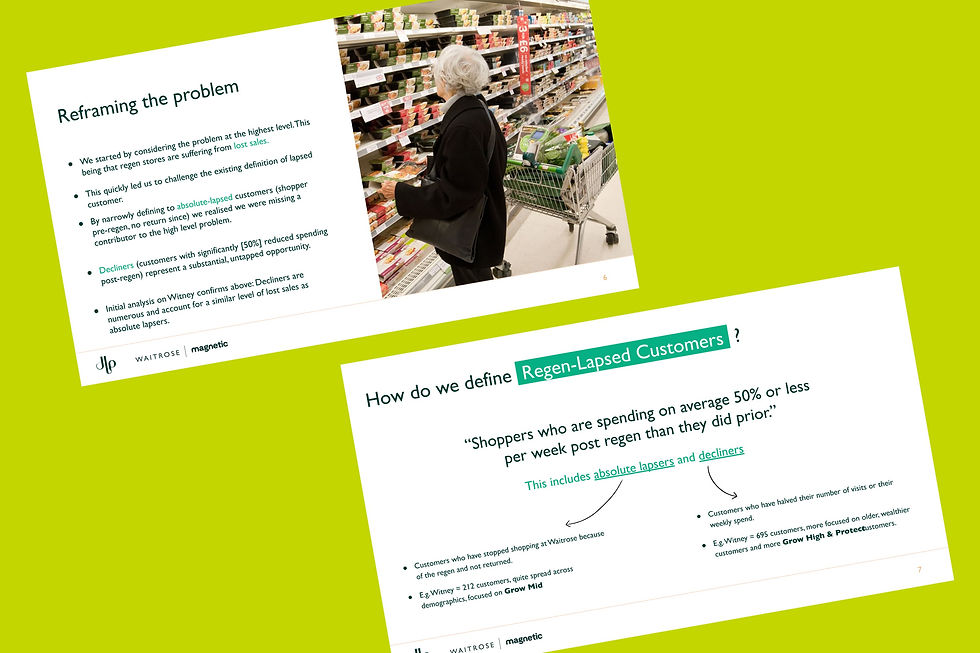
Design is only as good as the problem it’s solving. Working alongside a lead analyst from Newton, I led the team in reframing the problem. We moved away from vague "store improvements" and focused on two hyper-specific human behaviors:
-
The Absolute Lapses: Shoppers who had walked away entirely.
-
The Decliners: Regulars who had halved their weekly spend.
By defining a "50% spend drop" as our threshold, we gave our creative interventions a clear financial target. This wasn't just about aesthetics; it was about Recovering the Basket.
Guerrilla leadership
To move fast, I had to play ‘corporate diplomat’. Handling multiple stakeholders and organising direct access to the Waitrose design and CRM teams, and, crucially, gained permission to use a top-secret, unreleased brand identity.
By using the "New Waitrose" brand for our lo-fi experiments, we signalled to cynical customers that change was actually happening. I led a multidisciplinary task force (Designer, Service Designer, Analyst, and Junior Consultant) in a "Build-it, Break-it, Fix-it" loop. We built our ideas using "Experiment Canvases" that mapped every creative idea directly to a hypothesis and measurable KPI.


The Whitney experiments - in touch with customers
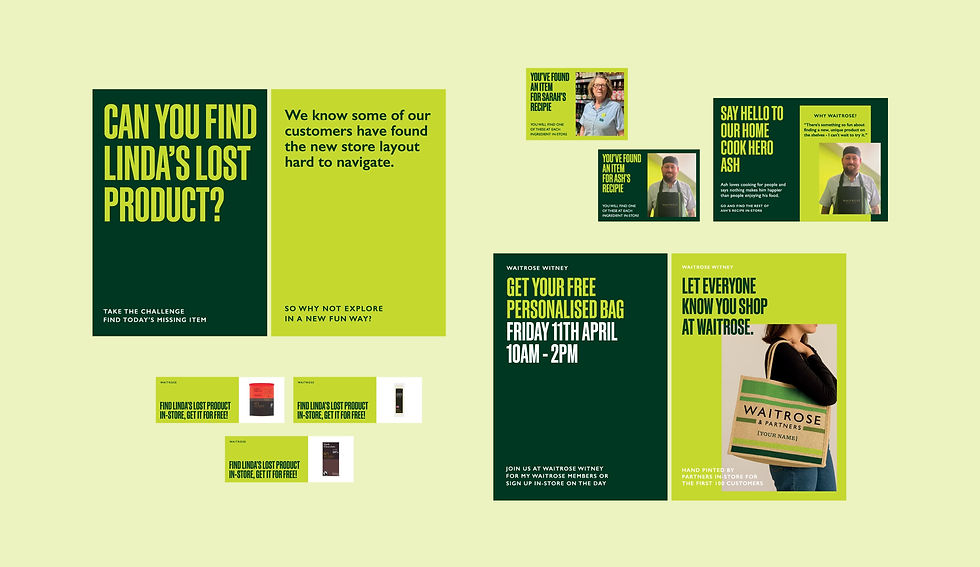
In the Whitney store, we tested the human element of our ideas to get closer to customers.
-
Linda’s Lost Product: A wayfinding intervention that used radical empathy to acknowledge the frustration of the new store layout.
-
Home Cook Heroes: Staff-endorsed recipe cards created a scavenger-hunt style trip around the store for any customer participating. We gave them the first ingredient for free as an incentive.
-
The Personalised Bag: I led the production of old-school letterpress bags that turned a grocery shop into an artisan event. We sold out in just 2 hours!
The Result: An 8.5% sales uplift and a 12% jump in customer satisfaction. We proved that a "Guerrilla" spirit could coexist with Waitrose’s premium DNA.


The Parkstone Pivot - going after lapsed customers
Pathz data from the loyalty cards showed us exactly where our lapsed customers were shopping: with the competition. We took our strategy to their doorstep.
-
The Bag Swap: We physically patrolled the streets outside rival stores, swapping competitors' bags for Waitrose ones—a bold visual provocation.
-
The £40 Shop: We used information design to showcase exactly how much value £40 gets you at Waitrose, debunking the "too expensive" myth.
-
The Door Drop: We hand-delivered 250 targeted vouchers to specific "lapsed" postcodes.
-
Waitrose Wednesday: to reinvigorate the cafe, bringing customers back to the store, driving footfall.


The £6M Legacy
The results at Parkstone were the "Mic Drop" moment. We saw a 21% sales uplift among Decliners and successfully reactivated 22 "Absolute Lapsed" customers in a single week.
But the real impact was the system. Our team created a Post-Regen Activation Playbook—an exhaustive guide that codified our "mischief" into a scalable corporate toolkit. Beyond the collateral, I personally upskilled our senior stakeholder in agile methodologies, leaving Waitrose with the tools to continue this pace long after we left. We didn't just solve a store problem; we identified a £3m–£6m national opportunity.


